


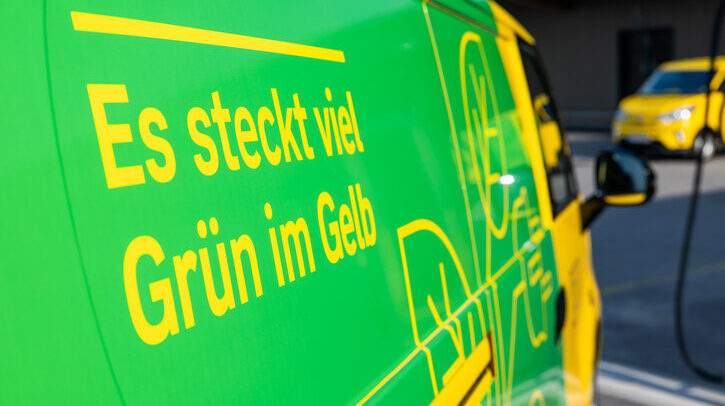
Austrian Post has begun testing bidirectional charging of five Maxus electric vehicles at its facility in Mautern an der Donau.
During the vehicle-to-grid (V2G) trial, which is being conducted in partnership with EVN and Netz Niederösterreich, the vehicles will be charged via ZAPe wall boxes from PEET and will also feed electricity into the public grid.
In combination with the photovoltaic system on the roof of the postal base in Mautern an der Donau, the electricity generated during the day is stored in the batteries of the electric vehicles during the vehicles’ downtime – for example, in the afternoon or on weekends – and released again later. The postal service’s electric vehicles thus act as a large, bundled electricity storage facility.
According to Austrian Post, the technology has the added advantage that electric vehicles can feed stored electricity – or electricity generated by photovoltaics – back into the grid at economically optimal times. This flexibility can be used to relieve the grid during bottlenecks, cap peak loads or increase the self-consumption of photovoltaic systems, which would ultimately relieve the public power grid.
This is the first time bidirectional charging has been trialled in Austria and Netz Niederösterreich and EVN are using the pilot test with Austrian Post to gain practical experience and develop possible future standards for the energy grid. According to Austrian Post, bidirectional charging will be possible in Austria from the beginning of 2027.
Peter Umundum, deputy CEO, member of the executive board for parcel and logistics, Austrian Post, commented, “Bidirectional charging is a possible next step: if the practical test is successful, our e-fleet could become a decentralized storage system. We already operate over 6,000 electric vehicles, more than 20MW peak photovoltaics, and a dense network of charging points throughout Austria. This project shows the potential of our infrastructure for Austrian Post and for the energy transition in Austria.”
Stefan Stallinger, chief technology officer, EVN, added, “We need bidirectional charging to integrate electric vehicles even more intelligently into the energy system in the future and provide valuable flexibility. Together with Austrian Post, we are taking an innovative step to test this technology in practice – and we are very pleased about the strong and constructive cooperation in this pilot project.”
Related news, Australia Post sets 2030 targets to cut emissions and increase circularity