


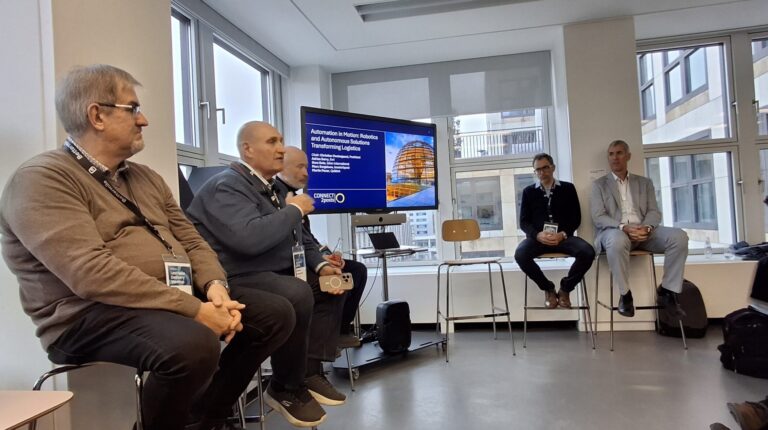
After the connect2posts summit in Berlin in January, PPTI caught up with Christian Oestergaard, lead visionary and senior group strategist at PostNord. He spoke to us about the importance of strong industry collaboration, meeting the challenges of rising consumer demand for convenient delivery solutions, and how technology is needed to solve the resilience challenges of the future
Why are industry events like the c2p summit important for postal and parcel operators globally?
c2p is a good way of attracting the startup community to our industry. It’s an enormous and cumbersome industry, and we don’t take fast decisions. With events like this, we can educate them to understand us better, so their pitches are not going above or below our heads. Many times, startups will say they have the solution to your problem without actually knowing what the problem is. They learn a lot from these events, and that is why we share a lot of our experiences and hold discussions.
This is a pretty unique industry in that it is so open in sharing. We want to create a successful ecosystem that works for everyone. At these events, there are many experts who are willing to share insights, and the startups can be nourished by that. When I talk with managers from other industries, they are often surprised by how open we are!
What are the biggest challenges currently facing postal and parcel operators in your market?
One of the big ones is convenience. It is becoming clearer to people what they can get from the market. Before, you gave customers one proposition and they took it. Now, competition is fierce. There are entries from all different angles – it could be Amazon, or from China, for example.
It is a much faster world now as things have become digitalized, and things are going to change even faster. There will be the impact of agentic AI, and changes to the ways that we purchase and the platforms we purchase from.
While these things bring challenges, it is a super-exciting time to be here. There is new technology coming in, and legacy structures that need to be changed. There are also now customers at both ends: there is the shipper who’s paying for the shipment, and the end consumer who is deciding whether they want to use you or not.
The market is less homogeneous than it used to be, which means that people who have been in the industry for a very long time need to change the way they make decisions. Being an operational industry, you are less likely to take on risk because you are doing the same thing every day. So a challenge arises when you retain this mindset but must rise to strategic challenges.
To make sure you make the right decision, you must ensure you understand your local market. There is no one-size-fits-all solution.
At PostNord, we are an organization that generates a lot of data, and up to now, we have never really used it to its full potential. Now is our golden time to figure out how to put it to use, as we take significant decisions on our infrastructure.
How is your organization adapting to changing customer expectations and delivery demands?
One of my takeaways from the summit was that the key questions are about infrastructure. Take out-of-home, for instance, which has been a huge topic. The change is coming from end consumers. They want a higher degree of flexibility and more control over the delivery. These developing expectations are bringing about structural changes, and the increasing demand for convenience is pushing us hard.
Let’s compare it with how food delivery has developed in the past several years, and think about how flexible that is. You can choose from any restaurant in the city, and also select based on whatever service level suits your needs. Do you need it in 15 minutes, or can you wait for 40? The customers say, “If it can work for food, why can’t it work for parcels?”
What role does technology play in shaping your strategy over the next few years?
One thing we expect to see over the coming years is fewer people coming to work in our industry. It is sometimes necessary to work during antisocial hours, or to handle heavy goods, or to deliver during the day in a lorry with no colleagues – for these reasons, it is not an industry that attracts people, particularly the younger generations. In this sense, technology can be a vital part of solving the resilience challenges of the future, if we can find ways to automate or robotize certain functions.
It is not just a question of resilience but also cost. The industry is very cost-competitive, being FTE and opex heavy – around 50% of our costs come from last-mile, which is mostly labor cost. Even with building lockers, it is a person’s job to fill and empty them, so it drives a lot of FTEs and these are getting scarce.
It is not just that young people are not interested in working for us, but that they are becoming fewer in number. Therefore, I think using technology will be essential to handle these challenges.
What opportunities do you see for collaboration across the global postal community?
Since we are not the fastest developers of technology, we can share experiences and learn from each other’s mistakes and successes. We are competing against companies who seemingly have endless funding. Since we don’t have that, we must be right with our investments much more than when we are wrong.
But it’s not just technology – it is vital to discuss approaches to all industry problems to understand what worked and what didn’t. By doing so, we can cut out a lot of mistakes, because in many cases we share the same problems. In Denmark, we do not deliver letters anymore, we only have parcels left. Yes, we are the first one, but others will follow, and it has been crucial for us to document the learning curve, so others can apply it to their own situation.