


The last-mile parcel delivery industry has spent years optimizing for speed. Faster sorting, routing, notifications and handovers. Customers wanted certainty, retailers needed shorter delivery windows, and courier companies had to manage growing volumes without letting costs spiral. Nowadays, speed still matters and it always will, but it is no longer the only key measure for how customers judge a delivery experience.
A parcel can arrive quickly and still create frustration. Maybe the recipient cannot change the delivery address, or the payment option is inconvenient. Maybe the pickup window does not fit their day, or a simple request still requires a phone call to customer support. The last-mile flow is full of these small moments. On their own, they may seem minor, but together, they shape how people feel about a carrier or a retailer.
An easier solution
The next major advantage in last-mile delivery comes from ease.
Ease means giving people the ability to act without constraints. It means making delivery understandable, secure and flexible, enabling customers to receive, send, pay, redirect, reschedule or even donate items through a flow that feels natural, preferably directly via their mobile phones. In recent years, the mobile app has become the clearest expression of this shift.
For many customers, the app is now the main interface with the courier company. It is where they check what is happening, take decisions, solve issues and manage preferences. A strong app can reduce pressure on support teams, prevent failed deliveries and increase trust. A weak one can make a delivery feel unnecessarily difficult, even if it arrives on time.
Users expect digital tracking. But they also crave full control. Can they change the delivery day? Can they redirect a parcel without calling anyone? Can they pay securely before pickup? Can they save the addresses they use most often? Can they send a parcel without printing a label? Can they manage notifications on their own terms? Can the same familiar flow help them do something new, such as donating items to an NGO they care about?
These are the kinds of questions that shaped the Sameday mobile app ecosystem, fueled by Movacy‘s capabilities. The app was designed around the everyday reality of recipients and senders. Users can see their active parcels, track deliveries in real time, view parcel history and access complete shipment details. They can also follow the courier on the map, with the same kind of visibility people now expect from food delivery or ridesharing apps. And when plans change, they can act immediately: they can reschedule the delivery, redirect it to another address, choose a different delivery option, send the parcel to a neighbor, cancel it directly in the app, or extend parcel storage time in the lockers – an option preferred by 83% of Sameday users.
This type of control matters because people do not organize their lives around parcels. They travel, work late, move between meetings, care for family members, forget pickup deadlines and change plans. And delivery needs to adapt to that reality, not the other way around.
The growing importance of C2C deliveries
For a long time, sending something felt like a separate logistics task, where users had to understand the process, prepare a label, estimate prices and sometimes move between channels just to complete the payment.
Shipments between individuals are becoming a stronger revenue stream, nearly doubling year-on-year and surpassing 1.5 million monthly active users for Sameday.
In the app, sending a parcel feels more like being guided through a familiar digital journey. The sender starts with the parcel itself, adds the recipient, chooses how the parcel will be handed over and how it should reach the other person, then sees the estimated cost and delivery timing before making a decision. From there, they can add other services, like parcel insurance, cash on delivery or parcel verification before acceptance and complete everything with a quick in-app payment.
These are small examples of a larger behavior change. Customers value services that help them stay in control without forcing them to understand the operational complexity behind the scenes. The more actions customers perform in an app, the more trust the app has to earn, making it part of a customer’s daily routine.
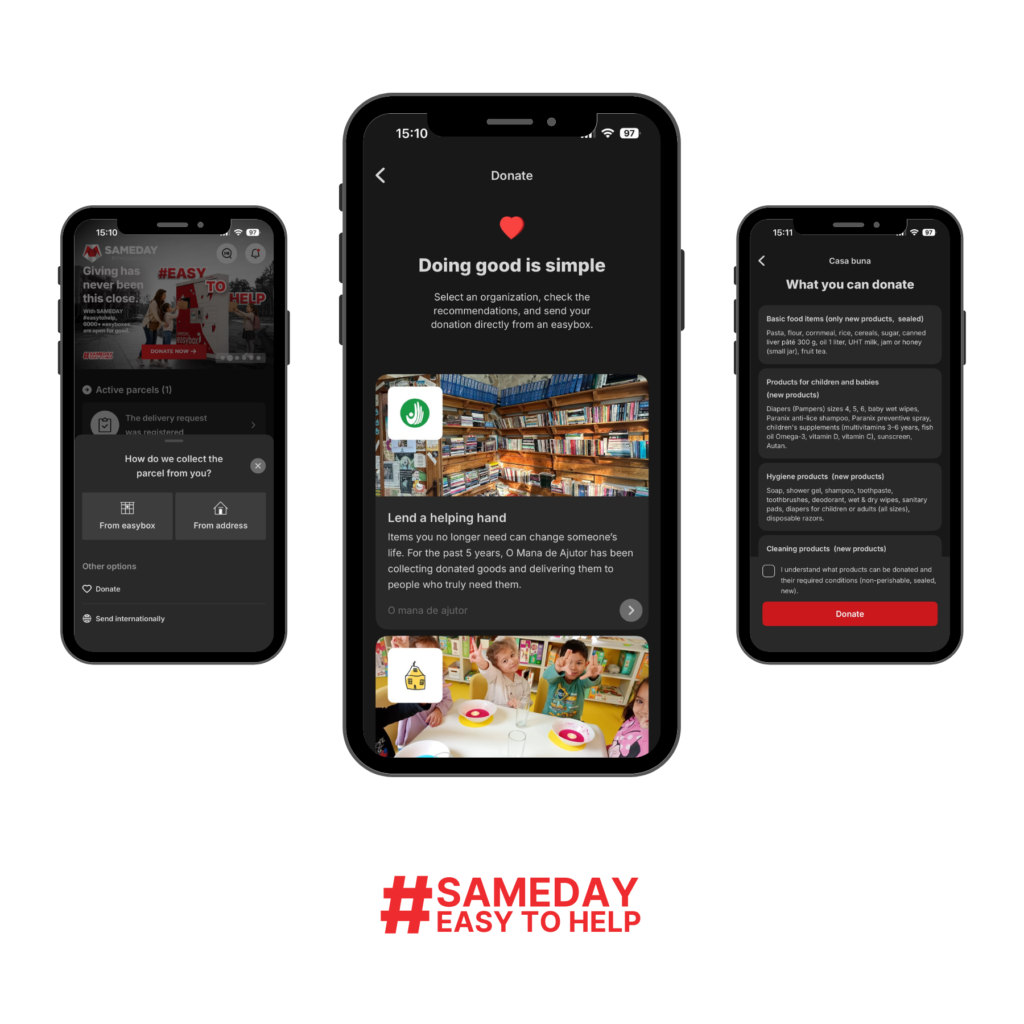
One of the most recent examples of this thinking is #easytohelp, a unique feature launched by Sameday in June 2026 and powered by the Movacy ecosystem.
The idea is straightforward: users can donate clothes, food or books to partner NGOs directly through the Sameday app. The AWB is generated automatically, and the user follows a familiar delivery flow. This is particularly important because donations often fail in the space between intention and action. Many people are willing to give, but the process can be unclear or inconvenient. They need to find the right organization, check what can be donated, understand the handover process and make time for it.
#easytohelp reduces that distance. It takes something people already know how to do in the app and applies it to a new purpose.
Early signals show the relevance of this approach: 65% of users said they were eager to donate through the app, while 95% preferred using the delivery infrastructure they already knew. Technology does not create generosity, but it can surely remove some of the friction that prevents people from acting on it.
This is a useful lesson for the entire industry. Customer experience improves when effort disappears from actions that matter. The future of delivery will still depend on strong operations. Parcels need to move quickly, networks need to scale and costs need to stay under control. But the experience customers remember will be shaped by something more inherently human: how easy it was to get things done.