


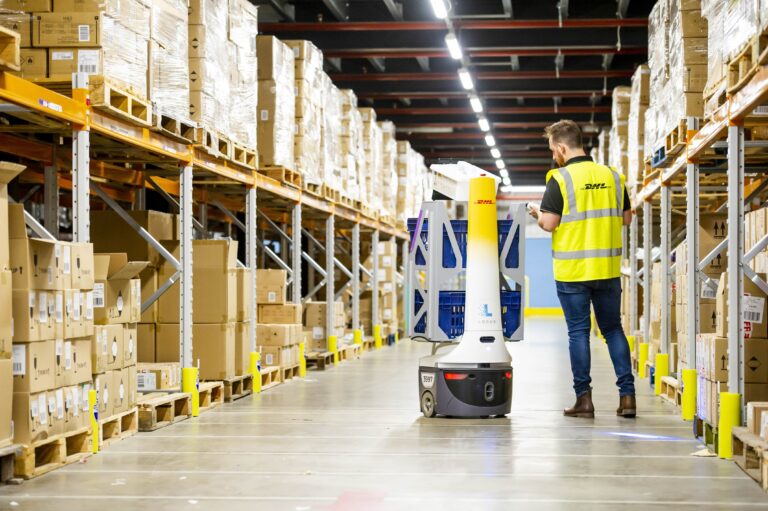
Artificial intelligence is moving beyond its role as a digital assistant and beginning to take autonomous action across supply chains, according to the eighth edition of DHL’s Logistics Trend Radar. The report says advances in AI, robotics and automation are reshaping not just logistics operations but the workforce itself, requiring organizations to rethink skills, safety, governance and employee experience.
“Supply chains are changing faster than ever as AI and workforce trends increasingly influence one another,” said Katja Busch, chief commercial officer at DHL and head of DHL Customer Solutions & Innovation. “The organizations that succeed will be those that understand these shifts early and are able to turn them into practical advantages for their business and their people.”
Among the report’s most significant findings is the emergence of agentic AI, which DHL describes as AI capable of autonomously planning, deciding and acting toward defined goals, rather than simply responding to prompts. Paired with AI analytics, which the report says helps organizations anticipate disruptions and forecast outcomes, DHL says these developments are enabling tasks such as anticipating inventory shortages, rerouting shipments around disruptions, and adjusting transportation capacity in real time. The report also highlights new trends including AI commerce, compute economy and humanoids, reflecting AI’s expansion beyond operational efficiency into purchasing, data center logistics and physical automation.
“Until now, AI has helped people perform tasks more efficiently. The next chapter is about action,” said Klaus Dohrmann, vice president of innovation and trend research at DHL Customer Solutions & Innovation. “We’re entering an era of autonomous and physical AI, where intelligent systems can actively perceive the world, navigate complex environments and make decisions with minimal human intervention.”
The report focuses on technologies including wearable sensors, remote operations, collaborative robotics and AI-powered workplace assistants, which it says are intended to create safer, more productive work environments by reducing repetitive tasks. Employee belonging and the augmented workplace are identified as key trends as staff increasingly work alongside AI tools.
“Technology is transforming the way we work, but people remain the driving force behind every successful supply chain,” said Thomas Ogilvie, chief human resources officer and labor director at DHL Group. “The future of logistics will not be defined by human versus AI, but by how effectively organizations combine human expertise with increasingly capable technologies.”
The report also points to AI ethics and cybersecurity 2.0 as trends addressing governance and oversight as AI takes on more autonomous responsibilities, alongside continued sustainability-focused trends such as decarbonization, sustainable fuels, circularity and vehicle electrification.
In related news, DHL expands global battery logistics network