


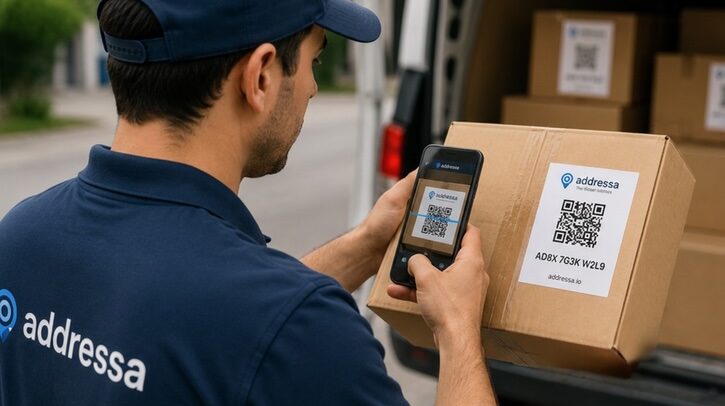
George Tabakyan, director of operations at OnyX Space, tells PPTI how the company’s space-based addressing system is transforming last-mile delivery
 Tell us about OnyX Space – why was the company launched and what issues does it aim to solve?
OnyX Space was founded in Singapore to bridge the gap between increasingly advanced satellite capabilities and the practical needs of businesses, governments and communities. Today, we have access to a large variety of Earth observation data, geospatial technologies and AI capabilities, but many organizations still struggle to turn these resources into simple, affordable and operational solutions.
Our aim is not merely to supply satellite imagery. We want to translate space-based data into tools that solve real-world problems – from monitoring infrastructure and supporting environmental applications to improving logistics and identifying locations that conventional addressing systems do not adequately serve.
Addressa emerged directly from this approach. While supporting volunteer work in remote communities, we repeatedly encountered people and work locations that were difficult to find. Directions often relied on landmarks such as ‘behind the school’ or ‘beside the third tree.’ It became clear that the problem was not that these locations did not exist, but that digital and logistics systems could not reliably understand them.
That experience led us to examine how satellite imagery, geospatial technology and AI could make locations easier for people and machines to identify and use.
Your Addressa solution is designed to provide precise, digital location information – how does the technology work and what are the benefits for last-mile delivery providers?
Addressa provides a simple digital identity for any geographic location, including places where conventional street addresses are incomplete, inconsistent or non-existent.
A user selects the precise destination on the Addressa platform. The system then generates a short, globally unique alphanumeric code and a corresponding QR code. This digital address can be shared with another person, attached to an online order or integrated into a logistics platform. The driver can open the location, navigate to it and, where applicable, include it in an optimized delivery route.
The principle is simple: select, generate, share and deliver.
Addressa is not intended to replace conventional street addresses or existing mapping platforms. It provides an additional digital location layer that makes an address more precise, structured and machine readable. For last-mile providers, this can reduce dependence on telephone calls, written explanations, shared live locations and informal landmarks. It can also help operators serve rural communities, informal settlements, industrial sites, construction areas and newly developed neighborhoods that may not have reliable addresses.
Most importantly, the same destination can be understood by the customer, logistics platform and driver, creating a more consistent flow of location information throughout the delivery process.
How does this more accurate and digitally connected address system improve efficiency, customer experience and delivery costs?
A significant amount of last-mile inefficiency occurs when the destination information provided during ordering is incomplete or interpreted differently by the customer, dispatcher and driver.
When a driver cannot identify a location, the consequences go beyond the additional driving time. The driver may need to call or message the customer, the dispatch team may become involved, other deliveries on the route may be delayed and, in some cases, the parcel may need to be returned and delivered again.
A precise digital address can address these inefficiencies at their source. Drivers spend less time searching for destinations, dispatchers receive more consistent location information, and operators have a better foundation for planning routes and allocating deliveries.
For customers, the experience becomes simpler. They do not need to repeatedly explain their location or remain available to guide the driver. This is particularly important in countries where addresses are frequently based on landmarks or where the same location may be described in several different ways.
For operators, fewer location-related calls, failed attempts and redeliveries can translate into lower operational costs. Over time, structured location data can also help identify recurring delivery difficulties, improve service-area planning and support more intelligent dispatch and routing decisions.
You’re exhibiting at Parcel+Post Expo on September 23-24 – what can visitors to your booth expect to see, and why are in-person events like this important for your company?
Visitors to stand P12 will be able to see how Addressa turns a selected location into a reusable digital address and QR code, and how that information can move from the customer to an order, dispatch process, route and final delivery.
We want the demonstration to be practical. Rather than discussing digital addressing only as a concept, we will show how a location can be selected, generated, shared and used by a delivery provider. Visitors will also discuss how the technology could complement their existing addressing, mapping and logistics systems.
Parcel+Post Expo brings together postal operators, courier companies, e-commerce platforms, technology providers and industry decision-makers. This makes it especially valuable for a solution such as Addressa, because addressing challenges vary significantly between countries, cities and individual operators.
In-person conversations help us understand those differences. They allow us to hear directly from delivery professionals about failed-delivery patterns, driver behavior, integration requirements and the limitations of existing systems. That feedback is essential for ensuring our technology responds to actual operational needs rather than assumptions.
The event is therefore not only an opportunity to demonstrate Addressa. It is also an opportunity to learn, identify potential pilot environments and build partnerships with organizations that understand the last-mile challenge firsthand.
How will Addressa, and Onyx Space more widely, continue to evolve to support the postal and logistics sector? What challenges do you plan to solve next?
Our immediate priority is to make digital addressing easy to integrate into the systems that postal operators, e-commerce platforms and last-mile companies already use. The technology must fit naturally into the ordering and delivery process without requiring customers or drivers to adopt complicated new procedures.
The next stage is to move from digital addressing toward delivery intelligence. Once locations are represented in a consistent and machine-readable format, they can be connected with order, dispatch and route data. This can support more efficient route planning, identification of difficult delivery areas, better service-area analysis and improved operational decision-making.
We are also considering the future requirements of autonomous delivery. Drones and other automated systems cannot rely on instructions such as ‘behind the school’ or ‘next to the third building.’ They require precise, structured and digitally accessible destinations. Making locations machine readable today helps establish the foundation for those future delivery models.
More widely, OnyX Space will continue combining satellite data, geospatial technology and AI to support the postal and logistics sector. This can include mapping underserved areas, analyzing transport and infrastructure networks, monitoring changes in rapidly developing locations and improving access to remote communities.
Our broader vision is that every location should have a deliverable digital identity. Better addressing is not only a logistics improvement – it can help connect people and businesses to e-commerce, financial services, emergency response and the wider digital economy.
You can find out more about Addressa and see a plethora of other technologies set to revolutionize the industry at Parcel+Post Expo, taking place at Excel London, September 23-24, 2026. Click here to register for your free visitor pass