


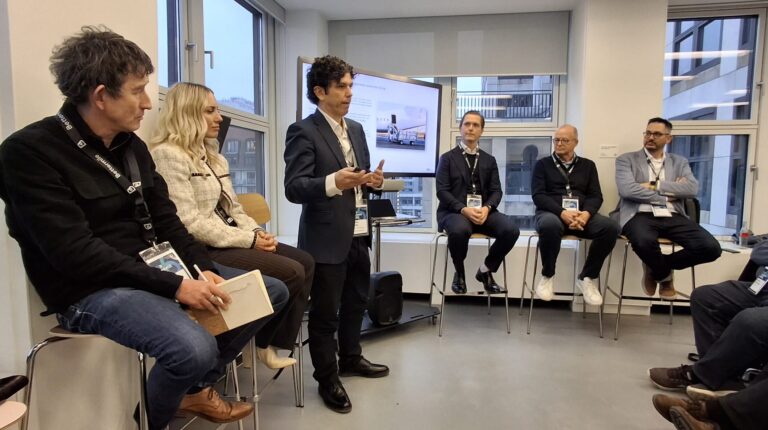
After the connect2posts Summit in Berlin, Germany, PPTI spoke with Carlos Setien, innovation manager at the International Post Corporation (IPC), who shared his insights on the value of intimate, expert-led forums, the evolving regulatory landscape in the EU, and how IPC supports postal operators in meeting rising consumer expectations. Carlos also highlighted the central role of innovation in the postal sector and how international collaboration can help operators deliver shared solutions more efficiently
Why are events such as the c2p Summit important for the IPC?
I found it very valuable. The forum itself has the perfect size. It brings together a high level of expertise among the participants, while still remaining small enough to allow for meaningful conversations. Unlike larger events, it’s easy to connect, exchange views, and have real discussions.
It also covered topics that are clearly very relevant and trending today, such as out-of-home (OOH) deliveries, the implementation of AI and regulatory changes.
For IPC, attending these forums is particularly useful to better understand what is happening outside our traditional environment and to explore whether there are things IPC could do together with its members to help support and accelerate this growth.
What are the key challenges facing the post and parcel industry at the moment?
In the EU, regulation around cross-border e-commerce has intensified significantly over the last few years. Starting with the removal of the VAT de minimis threshold in 2021 and implementation of ICS2 for risks assessments, and continuing with the recent announced measures to be implemented during 2026.
On July 1, 2026, the EU will abolish the €150 (US$178) duty-free threshold, meaning almost all imported goods, including low-value e-commerce parcels, will become subject to customs duty, with a temporary flat €3 (US$3.5) duty per item applied to small parcels. In addition, from November 2026, further customs reforms are expected, notably the introduction of additional EU-wide handling or processing fees, as part of the transition toward a more modernized EU customs framework and the creation of the EU Customs Authority and the EU Data Hub in mid-2028.
How is the IPC supporting postal operators as they respond to the changing market and consumer demands?
International Post Corporation is helping postal operators transition from traditional mail toward more data-driven, e-commerce solutions, both physical and digital. This includes providing shared platforms and services, performance measurement and carbon reporting, enabling posts to meet rising expectations around quality, features, visibility and sustainability.
On the specific challenge of customs regulation, IPC’s postal DDP (PDDP) solution is becoming a clear industry reference, supporting the upfront payment of taxes and duties. It helps operators remain compliant with major regulatory shifts, including the removal of the US$800 de minimis threshold in the USA, as well as upcoming changes to EU customs legislation in 2026.
How does innovation fit into IPC’s long-term plans?
IPC has had innovation at the core of its DNA since its foundation and, over the decades, has consistently delivered innovative solutions for its members and the wider postal industry.
While IPC has a strong track record of innovation, the environment in which it operates is evolving faster than ever. Customer expectations, technology, regulation and competition are all changing simultaneously and at increasing speed, calling for a more proactive, structured and forward-looking approach to innovation.
Where do you see the biggest opportunities for international collaboration in the postal sector?
Overall, the strongest opportunities lie in agnostic, shared solutions where IPC can act as an enabler, reducing duplication, accelerating adoption, and helping posts move faster and more efficiently together than they could individually, especially in areas where posts are not heavily competing. In these domains, IPC can foster trusted collaboration, pool volumes and capabilities, and deliver shared solutions that create value for all participants without distorting competitive dynamics.
Related, EXCLUSIVE INTERVIEW: Christian Oestergaard, PostNord