



Driving for work is one of the most dangerous activities employees undertake, and it’s unavoidable in the logistics sector. From the lightest urban delivery vehicles to the heaviest long-haul trucks, safer driving policies are contending with strict schedules, unpredictable conditions and quickly escalating parcel volumes. And there’s no simple solution to those challenges.
Predictably, safety is a strategic priority for fleets, according to Teletrac Navman’s UK product manager, Barney Goffer. Within the logistics sector, Teletrac Navman supports more reliable deliveries while cutting operational costs. However, the risks are changing as digital devices become more prevalent. The company’s recent survey of fleet operators found that 70% had been affected by distracted driving, with widespread impacts on costs (49%) and operations (40%).
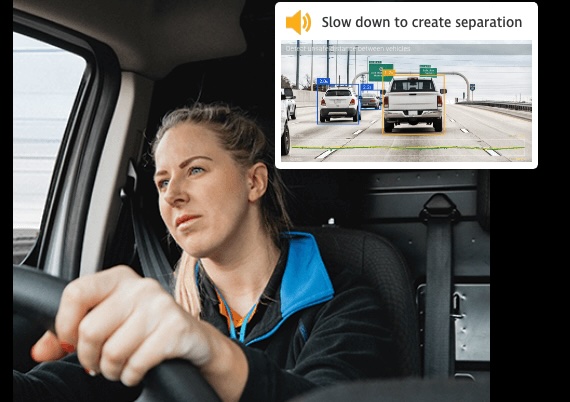
Thus, most (78%) are deploying advanced telematics solutions, including forward- and driver-facing cameras supported by digital coaching apps. According to Goffer, integrated AI is enabling those tools to become more proactive, supporting predictive maintenance and context-based situational analysis – for example, advising drivers to allow more space, or not penalizing them if they’re rightly braking abruptly to avoid a collision.
“Historically, our technology was about features such as poor driving behavior – if you can solve that, in theory, you create a safer driver,” Goffer comments. “That still has a place, but it doesn’t provide context and it always solves the problem after the event. By leveraging edge computing and AI, we can prevent the negative behavior in real time, through coaching in the cab.”
The most successful customer initiatives are delivering positive coaching and visibly rewarding good behavior through leader boards and awards, both of which improve driver buy-in. And Goffer notes that the wider use of big data can help achieve a more attractive working environment, too.
“Route optimization, warehouse management and transportation management systems all play their part in making the experience for the driver safer, better planned, optimized and a bit more predictable. It also gives you something to measure against – the camera data can be incorporated into that as well, in terms of how that vehicle has been driven, against its KPIs.”

Integrated data
Descartes is connecting the vast amounts of operational data amassed by logistics companies. Andrew Taverner, the company’s head of fleet marketing, EMEA, says customers are demanding more real-time visibility to support compliance, safety and timeliness, and solutions that support rather than monitor drivers. This means breaking down the data silos.
“Further integration remains important because many fleets still have legacy systems, third-party telematics, siloed training tools or separate compliance systems,” he asserts. “When these aren’t connected, data is lost, visibility is limited and safety gaps remain. Integration provides automatic triggering of safety-related issues before they become a problem.”
The Descartes platform is designed to link important elements, including a mobile app to capture vehicle faults early, telematics to monitor driver behavior and performance, and AI-based route adjustment to reduce the risk of poorly planned shortcuts. In turn, management and dispatch get better visibility and can intervene early where needed, and drivers benefit too.
Taverner continues, “Within the logistics sector we have a well-publicized shortage of drivers, continuous pressure to meet delivery demands, and rising costs. This may tempt some operators to push drivers’ hours and vehicle maintenance to the limits. Responsible operators will be managing their drivers’ workload within safe and legal drivers’ hours. This has the added benefit of reducing stress on drivers, which helps to retain them.”
Driver rewards
Improvement is a continuous process, according to Gavin Murdoch, MD of network transportation solutions at DHL Supply Chain UK&I. All new recruits at the company are given a defensive training program and paired with an experienced ‘buddy’ to guide them, while drivers are briefed on situational awareness initiatives and delivery point assessments. All Safety at Work processes are reviewed regularly to ensure they continue to adapt.
“Our dedicated Transport Development Centre has been designed to support both the recruitment and training of drivers, bringing every aspect of training and qualification under one roof and equipping our colleagues with the skills and information they need,” Murdoch explains. “Meanwhile, each of our sites has nominated driver assessors who have been trained to onboard new drivers in the use of our vehicles and associated technology. We regularly hold driver and trainer engagement sessions to build understanding and buy-in for new solutions.”
Bpost is also reaping the benefits of driver rewards, using dashboards to track accident rates and setting safety targets for operational managers. Detailed telematics with behavior monitoring has helped reduce minor incidents, while cutting diesel consumption by 10% – which national fleet manager Rik Vandenberghe believes should also translate into better EV range when more EVs are deployed, as operators understand how to drive more sustainably. Success relies on human interactions, as well as data, he asserts: “We ensure drivers understand how and why technologies are being implemented, and that these tools are designed to help them, not monitor them. We use coaching, training programs and feedback loops to promote adoption.
“Incentives also play a role. Drivers are eligible for performance bonuses based on penalty points and driving behavior. This aligns personal performance with company safety goals.
“Every quarter, we review all incidents in collaboration with insurance partners to identify trends and areas for action. This ensures that safety remains a living part of our operational culture. We also encourage drivers to provide input on routes, vehicle ergonomics or operational constraints that may impact safety. All our drivers receive regular safety training, including national and international eco-driving challenges, which contribute to safety and sustainability goals.”
Embracing technology
Active interventions can also help. Austrian Post is using advanced driver assistance systems (ADAS), such as parking aids and distance sensors, to improve safety and service quality.
For Felix Slavik, the post’s VP of fleet management, this has become a key part of vehicle procurement, delivering 15-20% cost benefits while benefiting efficiency and availability. The company also uses telematics to optimize its growing electric vehicle fleet, and plans to deploy safety-focused systems later.
“New technologies are introduced with active involvement from our drivers,” Slavik comments. “Our aim is to implement solutions that genuinely improve everyday work. Every step is carefully reviewed. The biggest challenge is integrating new systems into an existing fleet and workflow without disrupting ongoing operations.”
He adds, “In addition to technical measures, we actively promote a culture of safe driving. A key element is a financial incentive: drivers who avoid vehicle damage receive a bonus. This rewards responsible behavior on the road and reinforces awareness of safety and care in daily operations.”
Regulations are raising the bar for safety. The European Union’s General Safety Regulation 2 (GSR2) already requires features including blind-spot and reversing detection, speed-limit warnings and drowsiness detection in new vans and trucks. More advanced attention monitoring (with in-cab cameras) and standards for visibility will follow between 2026 and 2029.
DPD UK’s associate director for transportation and fleet, Darren Wilson, says these are welcome additions for safety-focused fleets, but adds that comms are vital. “Through digital communications and e-learning we are able to provide drivers with more frequent and immediate updates as well as clear instruction and information on how to utilize these features,” he explains.
“We welcome feedback from our drivers. Change can be scary, and when the change is moving toward vehicle autonomy, it can sometimes be a difficult sell to professional drivers. However, we work closely with driver and union representatives and put a lot of focus and time into awareness and training of new features or solutions. We focus on the positives for the drivers, and good-news stories are shared to evidence the value to our workforce.”
Vehicle manufacturers and technology suppliers also have a role in ensuring those solutions are deployed effectively. Tom Griffith, manager of Logistics UK’s Member Advice Centre (MAC), says the increasingly varied warnings can become a distraction if they’re hard to interpret.
“This can be especially prevalent with third-party systems that are retrofitted, as they may not be as seamlessly integrated as when the technology is built into the vehicle during production,” he notes, adding that this goes beyond directly safety-focused equipment.
“The use of screens in cabs can offer easy access to all the functions of a modern vehicle, but if it is not immediately obvious what some of the controls do, it can lead to distraction. If a driver needs to access the heating controls, for example, these should be immediately obvious and intuitive to use.”
Assistance features are also a step toward automated driving. Lynn Brown, vice president for human resources – UK and Ireland at XPO Logistics, believes these could help reduce human error and address challenges throughout a supply chain by providing more consistent first- and middle-mile operations and fewer fatigue-related incidents in long haul. With human supervision they could play a role in last-mile routes, too.
A need for standardization
In the meantime, today’s systems would benefit from increased standardization – especially fail-safes for drivers if they don’t apply the parking brake.
“Various control measures, such as audible warnings, dashboard lights and features that automatically use the park brake, have evolved but in an uncoordinated manner, as they were developed in isolation by manufacturers, maintenance engineers and vehicle operators,” Brown says.
“The lack of standardization creates a risk of driver error when operating a variety of vehicles. This remains a frustrating area requiring improvement. Where in-cab technology partly provides an answer, it needs to be legislated to be complete,” Brown continues.
However, she concludes, a safer fleet isn’t just about technology and compliance. Operators need to empower and support drivers through regular engagement – including well-being initiatives – to ensure safety is at the forefront in the workplace. This can help create a safe environment where employees are able to raise, and collaboratively address, any issues.
“Fleet safety is the cornerstone of resilience in the logistics sector,” confirms Brown. “Every mile traveled represents both opportunity and risk, and the ability to manage that risk effectively defines the strength of a supply chain. When a single incident can halt operations, damage reputation and incur significant financial and human costs, safety becomes more than a compliance requirement – it is a strategic imperative.”
Read the full article in the December 2025 issue of Parcel and Postal Technology International.