

Close Menu
Parcel and Postal Technology International
  • News
    • A-E
      • Automation
      • Business Diversification
      • Construction / Development
      • Cross-border
      • Delivery
      • E-commerce
      • Expo
    • F-O
      • Freight
      • IT & Systems
      • Last Mile
      • Lockers / PUDO
      • Logistics
      • Mail
      • Operations
    • P-R
      • Packets
      • Parcels
      • Peak
      • Retail
      • Returns
    • S-Z
      • Sorting Systems
      • Staff / Personnel
      • Sustainability
      • Technology
      • Vehicles / Fleet
  • Features
  • Online Magazines
    • September 2026
    • April 2026
    • December 2025
    • September 2025
    • June 2025
    • March 2025
    • December 2024
    • September 2024
    • June 2024
    • March 2024
    • September 2023
    • June 2023
    • March 2023
    • December 2022
    • SHOWCASE 2019
    • Archive Issues
    • Subscribe Free!
  • Opinion
  • Videos
  • Analysis
  • Podcast
  • Awards
    • 2025 Award winners
    • Previous Winners
  • Supplier Spotlight
  • Parcel + Post Expo
LinkedIn YouTube X (Twitter)
  • Sign-up for Breaking News Emails
  • Meet the Editors
  • Contact Us
  • Media Pack
Subscribe
LinkedIn Facebook
Parcel and Postal Technology International
  • News
      • Automation
      • Business Diversification
      • Construction / Development
      • Cross-border
      • Delivery
      • E-commerce
      • Expo
      • Freight
      • IT & Systems
      • Last Mile
      • Lockers / PUDO
      • Logistics
      • Mail
      • Operations
      • Packets
      • Parcels
      • Peak
      • Retail
      • Returns
      • Sorting Systems
      • Staff / Personnel
      • Sustainability
      • Technology
      • Vehicles / Fleet
  • Features
  • Online Magazines
    1. September 2026
    2. April 2026
    3. December 2025
    4. September 2025
    5. June 2025
    6. March 2025
    7. December 2024
    8. September 2024
    9. June 2024
    10. SHOWCASE 2019
    11. Subscribe Free!
    Featured
    July 28, 2026

    In this Issue – September 2026

    Online Magazines By Web Team
    Recent

    In this Issue – September 2026

    July 28, 2026

    In this Issue – April 2026

    April 16, 2026

    In this Issue – December 2025

    December 2, 2025
  • Opinion
  • Videos
  • Podcast
  • Analysis
  • Awards
    • 2025 Award winners
    • 2024 Award Winners
    • 2023 Award Winners
    • Previous Winners
  • Supplier Spotlight
  • Parcel + Post Expo
LinkedIn Facebook
Subscribe
Parcel and Postal Technology International
Opinion

OPINION: Building flexibility into Europe’s next locker networks

Albert Bladas, founder and CEO, ColumatBy Albert Bladas, founder and CEO, ColumatSeptember 22, 20264 Mins Read
Share LinkedIn Twitter Facebook Email
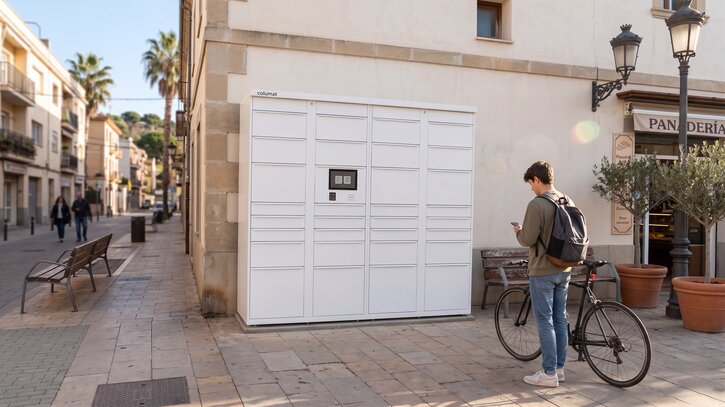
Man on bike stopped outside a parcel locker

Europe’s parcel locker market is expanding, but adoption is developing at very different rates across the continent. For operators, the challenge is therefore becoming less about deploying standardized networks and more about building infrastructure that can adapt to different markets, locations and delivery requirements.

The shift towards out-of-home (OOH) delivery is already well established. DHL’s 2025 E-Commerce Trends Report found that 35% of European shoppers choose an out-of-home location for deliveries, with 18% specifically selecting parcel lockers. Their role is also becoming increasingly relevant for returns, with 26% of European shoppers using lockers for this purpose.

However, consumer preferences vary considerably between countries. The same research found that parcel lockers account for 68% of stated delivery preferences in Poland and 56% in the Czech Republic, compared with 45% in Sweden. In Western and Southern Europe, the figures are lower, at 32% in Germany, 31% in Italy, 26% in France, 25% in the UK, 25% in Spain and 18% in Portugal.

The differences illustrate a broader challenge for logistics operators expanding across Europe. A network model designed for a highly mature locker market may not be equally suited to locations where home delivery, parcel shops or other OOH services remain more established.

Geopost’s 2025 E-Shopper Barometer, based on 30,700 online shoppers across 22 European countries, similarly identified parcel lockers as the second most preferred delivery option among European e-shoppers, behind home delivery. Together, these figures suggest that OOH infrastructure is becoming an established part of the delivery mix, while the requirements placed on that infrastructure are becoming increasingly diverse.

Increased functionality

This is creating interest in more flexible locker architectures. Columat’s latest Hybrid Smart Locker illustrates one approach. The system combines outdoor compartments for conventional parcel deliveries with temperature-controlled compartments operating between 2°C and 8°C. Both can be integrated into a single installation and managed through the same software environment.

The approach allows different types of deliveries to share physical infrastructure. Standard e-commerce parcels can be handled alongside temperature-sensitive products such as groceries, fresh food or pharmaceuticals, without requiring separate locker installations for each use case. The modular configuration can also be adapted to the requirements of individual locations.

This flexibility becomes particularly relevant in dense urban areas, where available space can be limited and each additional delivery point needs to justify its physical footprint.

Energy infrastructure represents another constraint. Conventional grid-connected lockers require suitable electrical access, which can make some strategically useful locations difficult or time-consuming to develop. Autonomous systems using solar generation and battery storage provide an alternative for sites where permanent grid connections are unavailable or impractical.

Columat has developed an off-grid configuration designed to operate independently of external electrical infrastructure. In practical terms, this expands the range of locations that can be considered for locker deployment and allows autonomous and grid-connected units to form part of the same wider network.

The development reflects a broader change in the role of parcel lockers. Rather than functioning solely as automated collection points, they are increasingly becoming distributed logistics infrastructure capable of supporting multiple delivery models.

Centralized control

Software is consequently becoming an important part of network management. Columat Manager provides centralized visibility of locker activity, access permissions, alerts and operational data, allowing different teams to manage deployments remotely. For networks distributed across multiple cities, this type of centralized control can reduce the complexity associated with monitoring individual sites and maintaining consistent operating processes.

Network scalability also depends on what happens beyond the initial installation. Site assessment, configuration, connectivity, maintenance and technical support all contribute to the operational performance of a locker network over its lifetime. As deployments grow, these factors can become as important as the physical capacity of the lockers themselves.

End-to-end solution

Columat currently has more than 7,200 lockers deployed across 380 cities and has processed more than three million exchanges. Its deployments cover the process from site analysis and engineering through manufacturing, software, installation and ongoing support.

The wider European market is unlikely to converge around a single locker model. Differences in consumer behavior, urban density, infrastructure availability and delivery requirements mean that operators will need to accommodate a variety of conditions.

For the next generation of OOH networks, the focus may therefore shift from simply increasing locker density to increasing the flexibility of the infrastructure itself. Modular configurations, temperature control and autonomous energy systems provide different ways of adapting a network to its environment, while centralized software can help operators manage that complexity at scale.

As parcel lockers become a more established component of European logistics, the ability to adapt infrastructure to different locations and delivery requirements could become as important as the number of compartments deployed.

Share. Twitter LinkedIn Facebook Email
Previous ArticleAdif and SICAN to split US$71m cost of intermodal terminal in Cantabria
Next Article DHL Express adds weekly freighter flight between Bahrain and Johannesburg

Related Posts

Opinion

OPINION: Fast and forgettable – why choice and reliability build consumer loyalty

September 18, 20266 Mins Read
Opinion

OPINION: Why the market has not created a universal digital mailbox on its own

September 14, 20266 Mins Read
Opinion

OPINION: Why postal operators are uniquely positioned to own trusted digital communication infrastructure

August 31, 20265 Mins Read

Receive breaking stories and features in your inbox each week, for free


Enter your email address:


Latest News

DHL Express adds weekly freighter flight between Bahrain and Johannesburg

September 22, 2026

OPINION: Building flexibility into Europe’s next locker networks

September 22, 2026

Adif and SICAN to split US$71m cost of intermodal terminal in Cantabria

September 21, 2026
Getting in Touch
  • Contact Us / Advertiser
  • Meet the Editors
  • Media Pack
  • Breaking News Emails
Our Social Channels
  • Facebook
  • LinkedIn
Supplier Spotlights
  • LEONARDO AUTOMATION
  • Cookie Policy
  • Privacy Policy
  • Terms & Conditions
  • Notice & Takedown Policy
  • Site FAQs
© 2026 UKi Media & Events a division of UKIP Media & Events Ltd

Type above and press Enter to search. Press Esc to cancel.

We use cookies on our website to give you the most relevant experience by remembering your preferences and repeat visits. By clicking “Accept”, you consent to the use of ALL the cookies.
Cookie settingsACCEPT
Manage consent

Privacy Overview

This website uses cookies to improve your experience while you navigate through the website. Out of these, the cookies that are categorized as necessary are stored on your browser as they are essential for the working of basic functionalities of the website. We also use third-party cookies that help us analyze and understand how you use this website. These cookies will be stored in your browser only with your consent. You also have the option to opt-out of these cookies. But opting out of some of these cookies may affect your browsing experience.
Necessary
Always Enabled
Necessary cookies are absolutely essential for the website to function properly. These cookies ensure basic functionalities and security features of the website, anonymously.
CookieDurationDescription
cookielawinfo-checkbox-advertisement1 yearSet by the GDPR Cookie Consent plugin, this cookie records the user consent for the cookies in the "Advertisement" category.
cookielawinfo-checkbox-analytics1 yearSet by the GDPR Cookie Consent plugin, this cookie records the user consent for the cookies in the "Analytics" category.
cookielawinfo-checkbox-functional1 yearThe GDPR Cookie Consent plugin sets the cookie to record the user consent for the cookies in the category "Functional".
cookielawinfo-checkbox-necessary1 yearSet by the GDPR Cookie Consent plugin, this cookie records the user consent for the cookies in the "Necessary" category.
cookielawinfo-checkbox-others1 yearSet by the GDPR Cookie Consent plugin, this cookie stores user consent for cookies in the category "Others".
cookielawinfo-checkbox-performance1 yearSet by the GDPR Cookie Consent plugin, this cookie stores the user consent for cookies in the category "Performance".
elementorneverThe website's WordPress theme uses this cookie. It allows the website owner to implement or change the website's content in real-time.
JSESSIONIDsessionNew Relic uses this cookie to store a session identifier so that New Relic can monitor session counts for an application.
Functional
Functional cookies help to perform certain functionalities like sharing the content of the website on social media platforms, collect feedbacks, and other third-party features.
CookieDurationDescription
__cf_bm30 minutesCloudflare set the cookie to support Cloudflare Bot Management.
Analytics
Analytical cookies are used to understand how visitors interact with the website. These cookies help provide information on metrics the number of visitors, bounce rate, traffic source, etc.
CookieDurationDescription
_ga1 year 1 month 4 daysGoogle Analytics sets this cookie to calculate visitor, session and campaign data and track site usage for the site's analytics report. The cookie stores information anonymously and assigns a randomly generated number to recognise unique visitors.
_ga_*1 year 1 month 4 daysGoogle Analytics sets this cookie to store and count page views.
CONSENT2 yearsYouTube sets this cookie via embedded YouTube videos and registers anonymous statistical data.
uidsessionThis is a Google UserID cookie that tracks users across various website segments.
vuid1 year 1 month 4 daysVimeo installs this cookie to collect tracking information by setting a unique ID to embed videos on the website.
Advertisement
Advertisement cookies are used to provide visitors with relevant ads and marketing campaigns. These cookies track visitors across websites and collect information to provide customized ads.
CookieDurationDescription
OAGEOsessionOpenX sets this cookie to avoid the repeated display of the same ad.
OAID1 yearCookie set to record whether the user has opted out of the collection of information by the AdsWizz Service Cookies.
VISITOR_INFO1_LIVE5 months 27 daysYouTube sets this cookie to measure bandwidth, determining whether the user gets the new or old player interface.
YSCsessionYoutube sets this cookie to track the views of embedded videos on Youtube pages.
yt-remote-connected-devicesneverYouTube sets this cookie to store the user's video preferences using embedded YouTube videos.
yt-remote-device-idneverYouTube sets this cookie to store the user's video preferences using embedded YouTube videos.
yt.innertube::nextIdneverYouTube sets this cookie to register a unique ID to store data on what videos from YouTube the user has seen.
yt.innertube::requestsneverYouTube sets this cookie to register a unique ID to store data on what videos from YouTube the user has seen.
Others
Other uncategorized cookies are those that are being analyzed and have not been classified into a category as yet.
CookieDurationDescription
VISITOR_PRIVACY_METADATA5 months 27 daysDescription is currently not available.
SAVE & ACCEPT
Powered by CookieYes Logo