


Europe’s parcel locker market is expanding, but adoption is developing at very different rates across the continent. For operators, the challenge is therefore becoming less about deploying standardized networks and more about building infrastructure that can adapt to different markets, locations and delivery requirements.
The shift toward out-of-home (OOH) delivery is already well established. DHL’s 2025 E-Commerce Trends Report found that 35% of European shoppers choose an out-of-home location for deliveries, with 18% specifically selecting parcel lockers. Lockers are also becoming increasingly relevant for returns, with 26% of European shoppers using them for this purpose.
However, consumer preferences vary considerably between countries. The same research found that parcel lockers account for 68% of stated delivery preferences in Poland and 56% in the Czech Republic, compared with 45% in Sweden. In Western and Southern Europe, the figures are lower, at 32% in Germany, 31% in Italy, 26% in France, 25% in the UK, 25% in Spain and 18% in Portugal.
The differences illustrate a broader challenge for logistics operators expanding across Europe. A network model designed for a highly mature locker market may not be equally suited to locations where home delivery, parcel shops or other OOH services remain more established.
Geopost’s 2025 E-Shopper Barometer, based on 30,700 online shoppers across 22 European countries, similarly identified parcel lockers as the second most preferred delivery option among European e-shoppers, behind home delivery. Together, these figures suggest that OOH infrastructure is becoming an established part of the delivery mix, while the requirements placed on that infrastructure are becoming increasingly diverse.
Increased functionality
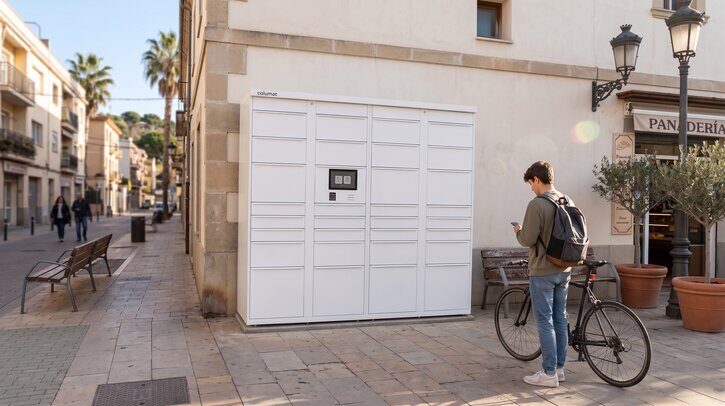
This is creating interest in more flexible locker architectures. Columat’s latest Hybrid Smart Locker illustrates one approach. The system combines outdoor compartments for conventional parcel deliveries with temperature-controlled compartments operating between 2°C and 8°C. Both can be integrated into a single installation and managed through the same software environment.
The approach allows different types of deliveries to share physical infrastructure. Standard e-commerce parcels can be handled alongside temperature-sensitive products such as groceries, fresh food or pharmaceuticals, without requiring separate locker installations for each use case. The modular configuration can also be adapted to the requirements of individual locations.
This flexibility becomes particularly relevant in dense urban areas, where available space can be limited and each additional delivery point needs to justify its physical footprint.
Energy infrastructure represents another constraint. Conventional grid-connected lockers require suitable electrical access, which can make some strategically useful locations difficult or time-consuming to develop. Autonomous systems using solar generation and battery storage provide an alternative for sites where permanent grid connections are unavailable or impractical.
Columat has developed an off-grid configuration designed to operate independently of external electrical infrastructure. In practical terms, this expands the range of locations that can be considered for locker deployment and allows autonomous and grid-connected units to form part of the same wider network.
The development reflects a broader change in the role of parcel lockers. Rather than functioning solely as automated collection points, they are increasingly becoming distributed logistics infrastructure capable of supporting multiple delivery models.
Centralized control
Software is consequently becoming an important part of network management. Columat Manager provides centralized visibility of locker activity, access permissions, alerts and operational data, allowing different teams to manage deployments remotely. For networks distributed across multiple cities, this type of centralized control can reduce the complexity associated with monitoring individual sites and maintaining consistent operating processes.
Network scalability also depends on what happens beyond the initial installation. Site assessment, configuration, connectivity, maintenance and technical support all contribute to the operational performance of a locker network over its lifetime. As deployments grow, these factors can become as important as the physical capacity of the lockers themselves.
End-to-end solution
Columat currently has more than 7,200 lockers deployed across 380 cities and has processed more than three million exchanges. Its deployments cover the process from site analysis and engineering through manufacturing, software, installation and ongoing support.
The wider European market is unlikely to converge around a single locker model. Differences in consumer behavior, urban density, infrastructure availability and delivery requirements mean that operators will need to accommodate a variety of conditions.
For the next generation of OOH networks, the focus may therefore shift from simply increasing locker density to increasing the flexibility of the infrastructure itself. Modular configurations, temperature control and autonomous energy systems provide different ways of adapting a network to its environment, while centralized software can help operators manage that complexity at scale.
As parcel lockers become a more established component of European logistics, the ability to adapt infrastructure to different locations and delivery requirements could become as important as the number of compartments deployed.