


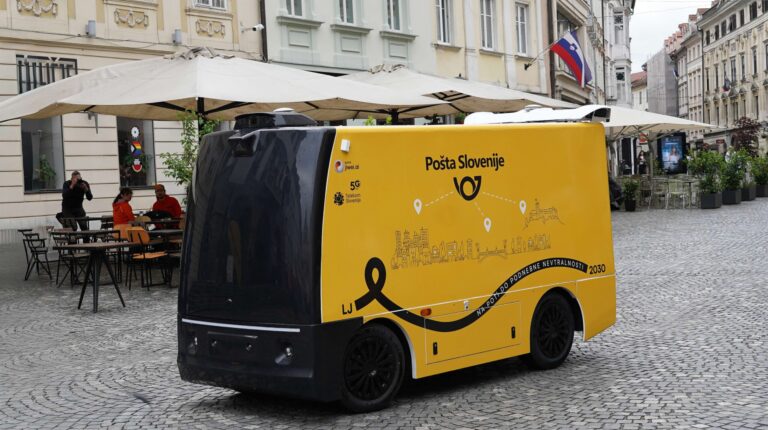
Pošta Slovenije and the City of Ljubljana have launched a pilot project testing assisted robotic delivery in the pedestrianized zone of Slovenia’s capital city, marking the first real-world trial of such a concept in the country.
The trial began at the start of June and demonstrates how robotic delivery technology could support last-mile logistics in urban environments with restricted vehicle access. The initial demonstration involved a delivery along the route from City Hall to the Soline shop.
The project is framed not solely as a parcel delivery solution, but as a broader urban delivery model. Future applications could include delivery of small retail purchases, local products, food and beverages, hygiene items and tourist information, as well as mobile kiosk or pick-up point services at public events.
Ljubljana mayor Zoran Janković highlighted the city’s history of pedestrianization as context for the initiative: “When we began gradually closing the city center to motor traffic nearly 20 years ago, the greatest sceptics feared that the city would lose its vitality. But the very opposite happened. Today, the city center is car-free, giving priority to pedestrians and cyclists, and it is full of life and diverse social activities. We have the largest pedestrianised zone in Europe, spanning nearly 20 hectares.”
Marko Cegnar, director general of Pošta Slovenije, said the aim was to supplement rather than replace existing delivery models: “Our aim is not to replace existing forms of delivery, but rather to supplement where traditional models are becoming less efficient – particularly in city centers, areas with restricted traffic, tourist hotspots and at public events.”
Cegnar added that while robotic delivery technology is already capable of autonomous operation, regulatory constraints mean it is being introduced gradually and in a controlled manner.
The project draws on expertise developed through TRACE, a European initiative in which Pošta Slovenije is working alongside more than 20 partners to develop smart, low-noise, carbon-free last-mile delivery models.
Last-mile delivery remains one of the most cost-intensive segments of the logistics chain, particularly in dense urban areas and pedestrian zones. Pošta Slovenije estimates that assisted and autonomous delivery solutions will become established in specific urban use cases over the coming years, though wider deployment will depend on advances in technology, infrastructure, user adoption and the legislative framework.
Related news, Last Mile Experts report maps out European OOH delivery market landscape