


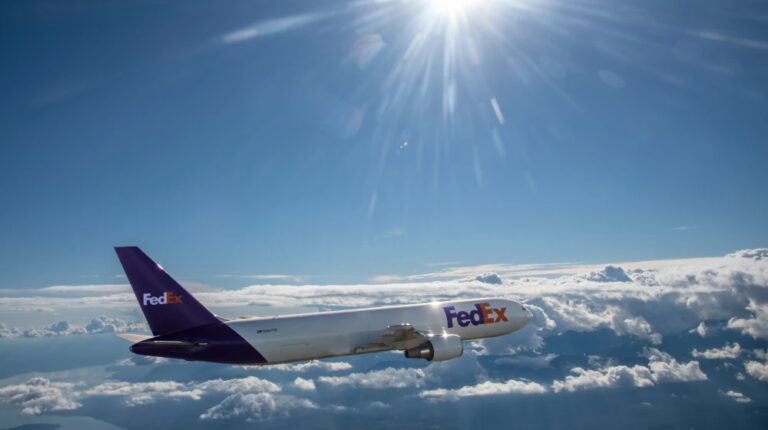
FedEx began using sustainable aviation fuel (SAF) at Chicago-O’Hare Airport and Miami International Airport last month, marking the company’s second and third deployments of SAF at a major US airport in six months following Los Angeles International Airport in May.
Karen Blanks Ellis, chief sustainability officer and vice president of environmental affairs at FedEx, said, “Each executed agreement signals to fuel producers that airlines are willing and eager collaborators to help to scale the SAF market.
“The aviation industry still faces a mismatch between available SAF supply and carrier demand, but we are encouraged by the early signs of increased SAF production globally this calendar year.”
Fedex will receive a blend to include one million gallons of neat SAF at a minimum blend of 30% from Air bp at O’Hare, and has started to receive three million gallons of blended SAF at 30% blend minimum from AEG at Miami.
According to FedEx, it is the first US all-cargo airline to deploy SAF at O’Hare airport.
Aviation sustainability strategy
Using blended fuels means airlines do not need to make any changes to existing aircraft engines or fuelling infrastructure. By 2030, Fedex aims to obtain 30% of its fuel supply from alternative sources on a blended basis.
Though total emissions of SAF and traditional jet fuels and SAF are similar when burned, the production of SAF produces significantly fewer lifecycle emissions compared with the extraction of conventional fuels.
However, reducing overall fuel consumption and increasing operational efficiency must go together with alternative fuel uptake to reach emissions goals.
Fedex reports that aircraft modernization and other fuel savings initiatives have enabled it to avoid the use of 140 million gallons of jet fuel in FY 2024, resulting in US$400m in savings for the company.
FedEx also reports that in FY 2024 it achieved its previous goal of a 30% reduction in aircraft emissions intensity from a 2005 baseline.
Upping its ambition, FedEx has since expanded this goal to target a 40% reduction in aircraft emissions intensity by 2034.
In related news, Australia Post accelerates decarbonization with electric truck trial and Ampol renewable diesel partnership