


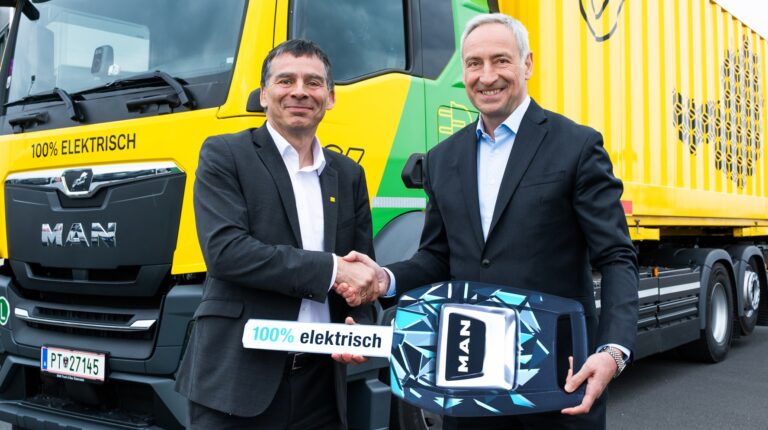
Austrian Post has announced that it will invest over €1.7m (US$2m) to expand its electric heavy-duty vehicle fleet, adding four new e-trucks into operation.
The postal service is showcasing two of its new e-trucks at the logistics centers in Kalsdorf near Graz (Styria) and Vomp (Tyrol). They will handle pickups from post offices and company locations, and transport parcels, letters and other shipments to their respective delivery depots.
Fast-charging stations have been installed at both locations, and charging reportedly uses only Austrian electricity from renewable energy sources.
Two additional e-trucks will be deployed in Vienna, increasing the total number of e-trucks operating there to four.
Peter Umundum, deputy director general and board member for parcel and logistics at Austrian Post, said, “With the new electric trucks, we are replacing four conventional diesel trucks, saving almost 189 tons of direct CO2 emissions per year. We are therefore not only expanding our electric fleet for deliveries but also working step by step on the transport logistics of tomorrow. From the post’s perspective, these new electric trucks represent an important step toward a lower-emission future, especially for Styria and Tyrol.”
Austrian Post has been using electric trucks in everyday operations since May 2024. Two vehicles have been regularly commuting between the Vienna-Inzersdorf logistics center and Vienna Airport, and have also been tested on various routes and elevation profiles throughout Austria. The positive operational experience forms the basis for the current fleet expansion in three federal states.
The acquisition was supported by the European Union’s Emission-Free Commercial Vehicles and Infrastructure (ENIN) funding program; the Austrian Federal Ministry for Climate Action, Environment, Energy, Mobility, Innovation and Technology; and the Austrian Research Promotion Agency (FFG).
The vehicles have six battery packs with 560kWh and a range of approximately 400km, intermediate charging from 20-80% in 90 minutes, a 400kW electric motor and gross vehicle weight up to 44 tons.
In related news, Dawsongroup reveals challenges slowing UK LCV fleet electrification