


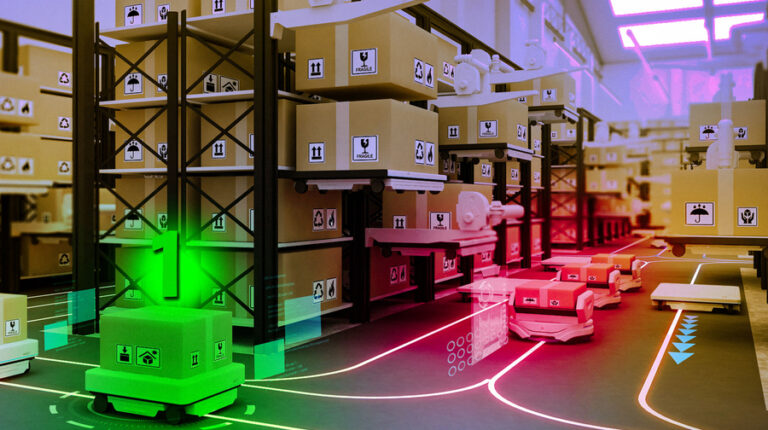
Researchers at MIT and automation company Symbotic have developed an AI-based system designed to improve traffic flow among robots in automated warehouses, reducing congestion and increasing throughput.
The approach uses deep reinforcement learning to determine which robots should be prioritized at any given moment, combined with a planning algorithm that directs robot movements in real time. The system is designed to anticipate bottlenecks and reroute robots before congestion occurs.
In simulations based on e-commerce warehouse environments, the method achieved an average 25% increase in throughput compared with conventional approaches.
The researchers said managing robot fleets in large warehouses is complex due to constantly changing conditions, including new tasks being assigned and fluctuating demand. Traditional systems often rely on fixed algorithms, which can struggle to adapt to congestion or disruptions.
Han Zheng, a graduate student at MIT and lead author of the study, said, “There are a lot of decision-making problems in manufacturing and logistics where companies rely on algorithms designed by human experts. But we have shown that, with the power of deep reinforcement learning, we can achieve super-human performance. This is a very promising approach, because in these giant warehouses even a 2 or 3% increase in throughput can have a huge impact.”
The system uses a neural network trained through simulations to evaluate warehouse conditions and assign priority to robots. It then applies a conventional path-planning algorithm to generate movement instructions, allowing robots to respond quickly in dynamic environments.
According to the research team, combining machine learning with established optimization methods improves performance compared with using either approach alone.
Cathy Wu, senior author of the study, said the hybrid model helps address limitations in both techniques. “Using expert-designed methods the right way can tremendously simplify the machine learning task,” she stated.
The system was tested in simulated warehouse layouts different from those used during training, demonstrating the ability to adapt to new environments with varying robot densities and configurations.
The technology is not yet deployed in live operations, but the researchers said it shows potential to improve efficiency in large-scale warehouse automation.
In the future, the researchers plan to include task assignments in the problem formulation, since determining which robot will complete each task affects congestion. They also plan to scale up their system to larger warehouses with thousands of robots.
In related news, THG Fulfil increases capacity with Libiao Robotics deployment